
Citizenship Answers
A free study platform for the USCIS naturalization civics test, covering all 128 official questions in 112+ languages.
Education / Immigration
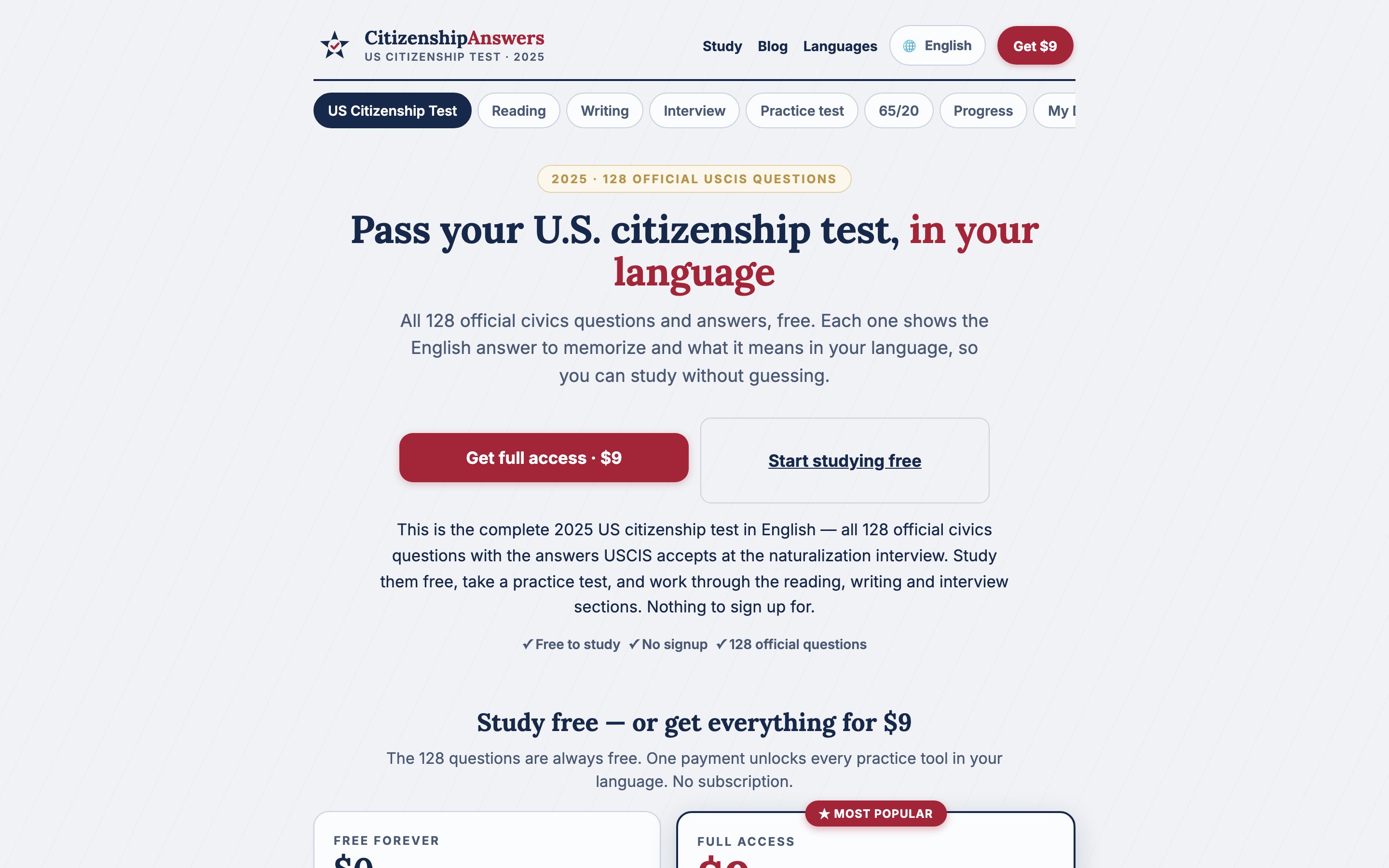
The civics test is one of the last things standing between a lawful permanent resident and US citizenship. USCIS publishes the material openly — the 2025 civics test is defined by the official study guide M-1778, which lays out 128 questions an applicant may be asked. The questions are public. The answers are public. On paper, this should be the easiest part of naturalization to prepare for.
In practice it is not, and the reason has almost nothing to do with civics.
The problem is the language, not the history
An applicant sitting the civics test has to answer in English. That is the requirement, and it is not negotiable. So a study list of 128 English questions with 128 English answers is asking someone to do two genuinely difficult things at the same time: understand what is being asked, and produce a specific English phrase from memory under pressure.
For an applicant whose first language is Spanish, Vietnamese, Tagalog, Amharic, or any of the hundred-odd other languages spoken by people going through this process, those two tasks pull in opposite directions. If you study only in English, you may end up memorising sounds you do not understand — which falls apart the moment an officer phrases the question slightly differently. If you study only in your own language, you understand the material perfectly and still cannot produce the answer you are required to give.
Citizenship Answers exists to separate those two problems and solve them in the right order. Understand the question in a language you actually think in. Memorise the answer in the language you have to say it in.
What the platform does
Citizenship Answers is a free study platform covering all 128 official questions from the 2025 civics test, sourced from USCIS M-1778. Not a sample set, not a "most likely" subset — the complete list, so an applicant is never studying against an incomplete picture of what they might be asked.
The material is available in 112+ languages. The question and its supporting explanation meet the applicant where they are; the answer they need to memorise stays in English, because that is what the test requires. That split is the whole product thesis, and it is the reason the language coverage is a feature rather than a translation exercise.
The core of the platform is free. There is a $9 premium tier for applicants who want more than the free experience. Nine dollars is a deliberate number for this audience. Naturalization is already expensive; a study aid that costs more than a couple of coffees prices out exactly the people who need it most.
Sourcing discipline was the hard requirement
Most of the engineering judgement on a project like this goes somewhere unglamorous: making sure the content is right and stays right.
An immigration study tool that drifts from the official source is worse than no tool at all. Someone using it is making decisions about a high-stakes government process based on what the screen tells them. So the content is anchored to a single authoritative source — USCIS M-1778 (2025) — rather than assembled from whatever civics material happened to be lying around the internet. When the official guide is the spine of the product, updates have one obvious place to come from, and there is never an argument about which version is correct.
The multilingual layer inherits that same discipline. Translating a question so an applicant understands it is helpful. Translating an answer so an applicant memorises the wrong thing is actively harmful. The rule that the English answer is never displaced is a content-integrity constraint, not a UI preference, and it is enforced structurally rather than left to whoever is adding a language.
Why this is a website-plus-app build
It is worth being precise about what kind of project this is, because it maps directly onto how Buck Ideas scopes work.
This is not a brochure site. There is real product behind it — a structured question bank, a large content surface that has to stay consistent across many languages, and a paid tier that has to actually work. But it is also not a platform in the sense of user-generated content, marketplaces, or complex multi-party permissions. The complexity lives in the content model and in getting the study experience right, not in the systems architecture.
That is the shape of a great many good ideas: substantial, valuable, and much smaller to build than the person with the idea assumes. Recognising that early is worth more to a budget than any technology choice made later.
How we approach builds like this
Buck Ideas builds with AI-assisted development and an engineer in the loop. That is our own practice, and it is what makes a project of this scope viable at a price a self-funded product can bear.
The pattern that makes it work is dividing the build into two piles. One pile is judgement: what the product actually is, what the content rules are, where the failure modes hide, what happens when someone relies on this for something that matters. That pile is human, and it is where the time goes. The other pile is production — scaffolding, structure, the long tail of screens and states, the repetitive work of making a large content set render correctly everywhere. That pile compresses enormously with modern tooling.
For a content-heavy product like Citizenship Answers, the second pile is large and the first pile is sharply defined. That ratio is exactly where AI-assisted development earns its keep. It is also why a project with 128 questions across 112+ languages is a reasonable thing for a small team to ship at all, rather than an enterprise content programme.
The takeaway
Free at the core, $9 if you want more, all 128 official questions, 112+ languages, sourced from the government's own study guide. The product is not clever. It is careful — and for something people are relying on during one of the more consequential weeks of their life, careful is the more valuable of the two.
If you have an idea shaped like this one — a real product with real content behind it, built for people who cannot afford a $50,000 agency engagement — that is the work we do.
Built by
At a glance
- Sector
- Education / Immigration
128
Official USCIS questions
112+
Languages supported
$9
Premium tier
Related reading
Want to know what a project like this costs?